Year's end and I think about events of the year, accomplishments, failures, happy times, family, and friends. I guess it's all considered just so much 'water over the dam', a phrase that apparently means the same thing as 'water under the bridge'. Though in this case, it's water over the falls.
Of all the definitions, Google's is the closest to what I am thinking about tonight. They suggest that those past events going over the dam are simply that -- the past -- so, "consequently, no longer regarded as important or as a source of concern."
But concern is exactly what I am feeling tonight -- that unfinished tasks from 2015 might be abandoned if we don't keep them in focus.
I have a list of them, and it's hard to arrange them into any firm priority. So, randomly, a year-end list of questions and causes that need some attention.
Why do the BC Ferries charge a reservation fee? The Washington State Ferries reservation only costs if you fail to show up when you said you would. Face it, it's a convenience for the company to know how many to expect. Maybe people showing up should pay an inconvenience fee for throwing out the count. And really, a higher rate if it's a last-minute reservation? I am shaking my head.
How does Christy Clark get away with acting so bossy? Does she think she is the Queen? Why did BC's taxpayers have to pay administration costs for a referendum with results that were a foregone conclusion (despite the $7 million campaign put up by the 'Yes' side). Why doesn't she have to have a referendum before she can commit ten billion (plus, you can bet) dollars of our money on the Site C Project. And how can she declare BC as not willing to participate in the strategy proposed towards repairing the Senate -- I'd think, where that's a federal proposal, she wouldn't have the authority to make such a decision.
But my last question is the saddest of all -- and the most important. Why has Rodney Watson still not been accepted as a refugee? He's been living in sanctuary since 2009 -- for a crime that should not have been considered a crime: leaving the US Army because he didn't want to kill. I don't want him going over the waterfall. I want our new federal government to recognize him as a seeker of refuge in Canada, to renew the promise of what our country stands for.
Warning: this is one of those blogs that goes all over the place. Poems, politics, gripes, praise. A little of everything from an avowed generalist.
Showing posts with label war resisters. Show all posts
Thursday, December 31, 2015
Monday, December 16, 2013
In darkness
It's the time of year when the darkness seems to want to take hold. Not only on the sky, but on life itself.
The light has been elusive, with today's sun finally rising at 8:01 and then setting again at 4:14. How many people spend their entire workday inside and miss the few hours of light? Go to work in the dark, come home in the dark, do it all over again the next day.
It hasn't helped the mood of things that government officials seemed to be running amok, out-Scrooging Scrooge with their meanness. Immigration services grabbed a man who'd spent the past 37 years of his life as a contributing community member on a small BC island. That story has at least seen a temporary resolution.
And though he's now apologized, when he was asked about child poverty, Minister of Industry James Moore remarked that it probably wasn't his "job" to feed his neighbour's children.
Another story -- and one that unfortunately still remains unresolved -- is that of Rodney Watson. He's the US war resister who's been in 'sanctuary' since September 18, 2009.
For being the season of supposed generosity, it's hard to see much of it in action.
Maybe with Saturday's Solstice, the light will be begin to return on more fronts than merely the sky.
Tuesday, May 01, 2012
Where's the fair in fairness?
And where is the just in justice? Looking in the dictionary hasn’t helped.
Yesterday’s decision permitting Conrad Black back into Canada makes me wonder what’s going on in this country – a country once known for its compassionate sense of justice.
Black was convicted of serious crimes, which in itself is supposed to make him less-than-welcome. Beyond that, in the interests of acquiring a lordship in England, Black officially renounced his Canadian citizenship.
So why, I ask, does the red tape fly out the door and the gold-plated welcome mat get laid at his feet?
The unfairness of this decision seems even more horrific when contrasted with the case of Rodney Watson. He’s the American soldier who found Iraq to be more than he’d bargained for, and quite a contrast to what he’d been told to expect. Like so many other soldiers of conscience, he left the US army and headed for Canada, where he thought he would find asylum.
Only Watson hasn't been granted asylum in our country. Rather, he has been residing in sanctuary provided by Vancouver’s First United Church.
The full horror of his situation sinks in when you realize he's been living at the church since the autumn of 2009 – nearly three years.
Yet Conrad Black waltzes in after waiting a day.
Is it simply because Rodney Watson doesn’t have the kind of bankroll Conrad Black has?
Like I said, could somebody please show me what’s fair about this?
Yesterday’s decision permitting Conrad Black back into Canada makes me wonder what’s going on in this country – a country once known for its compassionate sense of justice.
Black was convicted of serious crimes, which in itself is supposed to make him less-than-welcome. Beyond that, in the interests of acquiring a lordship in England, Black officially renounced his Canadian citizenship.
So why, I ask, does the red tape fly out the door and the gold-plated welcome mat get laid at his feet?
The unfairness of this decision seems even more horrific when contrasted with the case of Rodney Watson. He’s the American soldier who found Iraq to be more than he’d bargained for, and quite a contrast to what he’d been told to expect. Like so many other soldiers of conscience, he left the US army and headed for Canada, where he thought he would find asylum.
Only Watson hasn't been granted asylum in our country. Rather, he has been residing in sanctuary provided by Vancouver’s First United Church.
The full horror of his situation sinks in when you realize he's been living at the church since the autumn of 2009 – nearly three years.
Yet Conrad Black waltzes in after waiting a day.
Is it simply because Rodney Watson doesn’t have the kind of bankroll Conrad Black has?
Like I said, could somebody please show me what’s fair about this?
Wednesday, November 02, 2011
Anniversaries and other observances
There’s something about November that lends itself to remembering. And it’s not just the fact of Remembrance Day on the 11th.
Even the words form a kind of imperfect rhyme: ‘November / Remember’.
On a happy note, today is the day to observe the 75th birthday of our national public broadcaster, the CBC. Even people who don’t listen to it mostly acknowledge the value of having such a system in place – and commercial-free at that! I can’t describe the many things I’ve learned or been entertained by or fascinated by – just by the sounds that come out of that little black box in my kitchen.
Today is also the day we still celebrate our friend Miki’s birthday. We even ate some wild mushrooms with our supper in his honour.
But that flame in today’s image is also there to observe the anniversary of Norman Morrison’s self-immolation. Technically, he wasn’t the first to take such drastic action, but he did it outside the office of then-Secretary of US Defense, Robert McNamara.
Morrison’s death marked another turning point (or maybe it was a ratcheting-up point) in the rise of the movement that helped bring an end to the Vietnam War.
Thinking of that brave 31-year-old (far braver than I will ever be) renews my faith in the idea of hoping for change. And while I’m not extolling any more self-immolations, I am firmly believing in the power of the people, especially as represented by those who comprise the Occupy-Wherever forces. May they continue speaking out, and continue to do so with the voice of consensus.
Even the words form a kind of imperfect rhyme: ‘November / Remember’.
On a happy note, today is the day to observe the 75th birthday of our national public broadcaster, the CBC. Even people who don’t listen to it mostly acknowledge the value of having such a system in place – and commercial-free at that! I can’t describe the many things I’ve learned or been entertained by or fascinated by – just by the sounds that come out of that little black box in my kitchen.
Today is also the day we still celebrate our friend Miki’s birthday. We even ate some wild mushrooms with our supper in his honour.
But that flame in today’s image is also there to observe the anniversary of Norman Morrison’s self-immolation. Technically, he wasn’t the first to take such drastic action, but he did it outside the office of then-Secretary of US Defense, Robert McNamara.
Morrison’s death marked another turning point (or maybe it was a ratcheting-up point) in the rise of the movement that helped bring an end to the Vietnam War.
Thinking of that brave 31-year-old (far braver than I will ever be) renews my faith in the idea of hoping for change. And while I’m not extolling any more self-immolations, I am firmly believing in the power of the people, especially as represented by those who comprise the Occupy-Wherever forces. May they continue speaking out, and continue to do so with the voice of consensus.
Friday, May 27, 2011
Re Highway 61 Visited
One of my heroes made an album with a similar title. Same highway, even if I didn't make it as far south as Minneapolis and St. Paul. Or for that matter, even Hibbing. So much for birthplace quests.
Must say, I like the fact that the green sign offering distances lets you know how far to the Canadian border. There was a time when that distance was mighty significant to a lot of travellers, especially young men seeking asylum.
Wednesday, May 05, 2010
Too many anniversaries
Yesterday marked 100 years since Canada's navy was created by the Naval Service Act. And now, in a bizarre twist of fate, 37-year-old Craig Blake has become the first member of Canada's navy to die in Afghanistan. He was a member of the Navy's bomb disposal units -- and no, I don't know why that truck was in my neighbourhood, other than so I could take its picture. Yesterday was also the day to remember some other senseless deaths, the four who were killed by National Guardsmen at Kent State University in Ohio.
So much for "Peace Now", eh.
Friday, October 23, 2009
A day of observances
Every year I make a point of attending at least one of the many sessions offered at the Vancouver International Readers' and Writers' Festival. Despite the rains, I headed into the city and was well-rewarded for my efforts with a stimulating session featuring several interesting writers.
But looking back, a much more important part of the day was a side trip I took to
the core of the Downtown East Side. I went to the First United Church, the place where U.S. war resister Rodney Watson has taken sanctuary in hopes of not being deported and likely imprisoned in America.
We spoke for a little while, and he confirmed that when he'd joined the U.S. military, it had been with the understanding that he'd serve as a cook. When that turned out to not be the case -- and when they tried to extend his contract and send him for a second tour of duty to Iraq, he deserted and came to Vancouver.
I've written to our government before, recommending compassion for war resisters. My local MP, to give him credit, has at least replied -- but with legalese gobbledygoop as excuses -- despite the fact that the very Parliament (of which he's a member) has passed two previous motions suggesting that war resisters once again (as in Vietnam days) be permitted entry. Currently, there is a private member's bill even more specific to this issue.
There's a twist to all of this -- one that only dawned on me as I was getting off the bus near the church. Today is the anniversary of my receiving my own Canadian citizenship. Heck, they let me stay, and the fact of that made me feel both embarrassed and ashamed about Rodney's predicament.
I'm very glad I got to spend a bit of time with Rodney -- particularly on such a significant day. I had tears in my eyes when he hugged me. He was awaiting a call from Ron Kovic, the Vietnam vet who wrote Born on the 4th of July. All I can hope is that Kovic will have some good ideas to help Rodney Watson and the rest of the war resisters be heard.
But looking back, a much more important part of the day was a side trip I took to
the core of the Downtown East Side. I went to the First United Church, the place where U.S. war resister Rodney Watson has taken sanctuary in hopes of not being deported and likely imprisoned in America.We spoke for a little while, and he confirmed that when he'd joined the U.S. military, it had been with the understanding that he'd serve as a cook. When that turned out to not be the case -- and when they tried to extend his contract and send him for a second tour of duty to Iraq, he deserted and came to Vancouver.
I've written to our government before, recommending compassion for war resisters. My local MP, to give him credit, has at least replied -- but with legalese gobbledygoop as excuses -- despite the fact that the very Parliament (of which he's a member) has passed two previous motions suggesting that war resisters once again (as in Vietnam days) be permitted entry. Currently, there is a private member's bill even more specific to this issue.
There's a twist to all of this -- one that only dawned on me as I was getting off the bus near the church. Today is the anniversary of my receiving my own Canadian citizenship. Heck, they let me stay, and the fact of that made me feel both embarrassed and ashamed about Rodney's predicament.
I'm very glad I got to spend a bit of time with Rodney -- particularly on such a significant day. I had tears in my eyes when he hugged me. He was awaiting a call from Ron Kovic, the Vietnam vet who wrote Born on the 4th of July. All I can hope is that Kovic will have some good ideas to help Rodney Watson and the rest of the war resisters be heard.
Tuesday, January 20, 2009
Yet another irony
This is supposed to be the day when Hope takes over after too many years of letting ourselves be ruled by Fear. Even this rock down on the beach looks to be in agreement.Yet today, when so many people are celebrating the cause of freedom and new beginnings, our Canadian government plans to start deporting a number of American soldiers who sought refuge in our midst. These are people who stood up for their principles, who didn't want to do battle in a war they couldn't believe in. Only this Canada of 2009 is sending them back to the U.S.
This despite the fact that Parliament dealt with a motion last June (yes, more than half a year ago) that would allow objectors and resisters to stay here.
Anyone on Facebook might be interested in seeking out the group called 'War Resister Action: Let Them Stay Week'. They've outlined a number of measures we can participate in to show our distaste for this current stance. Truly, I am embarrassed over this lapse in understanding who we are and what Canada has always stood for -- right back to the days of the Underground Railway.
Tuesday, July 15, 2008
A bad day for Canada
In fact, a day of shame.
The freshly released video of CSIS interrogating the then-16-year-old Omar Khadr in Guantanamo raises more questions about Canada's complicity in allowing a Canadian -- and an underage one at that -- to spend so many years in an unsanctioned prison.
As if the release of that video wasn't enough cause for shame, today was also the day Canada deported Robin Long, one of the 200 or so American soldiers who have come to Canada because they disagree with Bush's war on Iraq.
The most fitting comment on these events seems to be a section from Keith Maillard's "The Intervention of the Duke" (a piece from his book, Dementia Americana, Ronsdale Press, 1994 which also appears in Crossing Lines, an anthology from Seraphim Editions, 2008). The brilliant leader referred to in the poem is none other than Pierre Elliott Trudeau, a Canadian prime minister who was unafraid to stand up on behalf of Canada and the country's code of honour.
-22-
He doesn't look half bad twenty years later --
the only statesman in the western world
who would allow himself to be photographed
upside down above a trampoline. He said no
you may not inquire of any young man arriving at the border
as to his status in the armed forces
of the United States of America.
We thought Canada meant peace.
My eyes filled with tears when I crossed
into Quebec and saw the Maple Leaf flying.
As soon as I could, I became a citizen.
For all my jokes about maple syrup, I was proud.
Now it makes me sick to see my country play the yapping cur,
chasing the tail of the American dog gone barking into war.
- -
O, Stephen Harper, if only you could take a page from the annals of your predecessor. What a great country we might once again be.
The freshly released video of CSIS interrogating the then-16-year-old Omar Khadr in Guantanamo raises more questions about Canada's complicity in allowing a Canadian -- and an underage one at that -- to spend so many years in an unsanctioned prison.
As if the release of that video wasn't enough cause for shame, today was also the day Canada deported Robin Long, one of the 200 or so American soldiers who have come to Canada because they disagree with Bush's war on Iraq.
The most fitting comment on these events seems to be a section from Keith Maillard's "The Intervention of the Duke" (a piece from his book, Dementia Americana, Ronsdale Press, 1994 which also appears in Crossing Lines, an anthology from Seraphim Editions, 2008). The brilliant leader referred to in the poem is none other than Pierre Elliott Trudeau, a Canadian prime minister who was unafraid to stand up on behalf of Canada and the country's code of honour.
-22-
He doesn't look half bad twenty years later --
the only statesman in the western world
who would allow himself to be photographed
upside down above a trampoline. He said no
you may not inquire of any young man arriving at the border
as to his status in the armed forces
of the United States of America.
We thought Canada meant peace.
My eyes filled with tears when I crossed
into Quebec and saw the Maple Leaf flying.
As soon as I could, I became a citizen.
For all my jokes about maple syrup, I was proud.
Now it makes me sick to see my country play the yapping cur,
chasing the tail of the American dog gone barking into war.
- -
O, Stephen Harper, if only you could take a page from the annals of your predecessor. What a great country we might once again be.
Friday, June 06, 2008
Bobby Kennedy was shot 40 years ago

Actually, 40 years ago yesterday. Here, if you're up for it, is a long rant that partially documents how that event had a profound impact on my life.
- -
People used to ask, ‘Where were you when Kennedy was shot?’ Always a good conversation starter, it was assumed you’d have some kind of story about where you were and what you were doing on November 22, 1963.
That particular Friday became a kind of touchstone for change, one that marked a country’s loss of innocence. It was the end of an era that had been portrayed by the Cleaver family on Leave it to Beaver, and later, by the Cunninghams on the series with the overly rosy name, Happy Days.
I think of that Friday in 1963 as only the beginning of the change. Because the date I see as being more profound is June 5, 1968. That’s the date another Kennedy, Robert – or Bobby as he was known – met the same fate as his brother John.
The first months of 1968 had seen the beginnings of a shift in the general public’s attitude toward the ongoing war in Vietnam. Early in January, the much-respected baby-and-child-care expert, Dr. Benjamin Spock, was indicted for promoting draft evasion. Month’s end saw the sweeping Tet offensive, a series of attacks that reached as far as the US Embassy in Saigon. People were finally starting to realize just how pointless America’s war efforts were. When, at the end of February, CBS newsman Walter Cronkite made comments on the apparent futility of the exercise, then-president Johnson supposedly remarked on the significance of the newsman’s words: “If I’ve lost Cronkite, I’ve lost middle America.”
I’d been on the fringes of an organization in Milwaukee that offered advice and other assistance to draft resisters. Being part of such a milieu, I couldn’t help being around people who were working on the campaign to put anti-war candidate Eugene McCarthy on the presidential ballot. They were a dedicated and interesting mix – speechwriters, organizers and a slew of pamphleteers.
The spring of ’68 had also been one where more than the weather was heating up. In part, due to the previous summer’s inner-city riots, and especially after the murder of Martin Luther King, Jr. in April, there was an ever-increasing sense of living in a police state. Many of us found we couldn’t go out without spotting unmarked police cars trailing us; police photographers seemed to be at every war protest and be-in; men with long hair were routinely stopped as they walked down the street, with the demand that they show their draft card (men who couldn’t produce one were arrested on the spot, as this was a serious offense). Yet despite all that, and despite the ever-increasing death count in Vietnam, there was an optimistic atmosphere of promise in the air. Promise that things were going to take a turn – and for the better.
Only then, on the cusp of summer, Bobby Kennedy was shot and killed. And for many of us, that event made it clear: no dreams were safe.
About a month later, my son Jeremy was born. Giving birth, especially to a son, did a lot to shift my perspective. Suddenly, I understood that I wasn’t going to be going to Chicago with my friends to be part of the protests outside the Democratic Convention. All of us understood that Chicago wasn’t going to be just another protest; this one would have Mayor Richard Daley’s specially trained riot forces on patrol. I understood that as a single mother, I now had responsibilities that meant I couldn’t risk getting myself arrested and thrown into jail. I also realized that my little boy was no different, only younger, than all those other boys being drafted for Vietnam.
It wasn’t very many months later that Jeremy and I were sitting in a very bright room in the bowels of the airport in Toronto. As I remember it, even though it was late in the evening, the immigration officers were super nice as they asked me questions and filled in the blanks on what seemed to be a very long form. They were coochie-cooing Jeremy and nodding with approval at the fact that I’d taken a few French courses. Of course it helped that Jeremy and I had a sponsor, no matter that the sponsorship eventually didn’t work out. So, bingo presto lucko – we were in, and told to expect our landed immigrant papers in the mail in just a few weeks.
But lately, things are different. The news keeps reporting changes to Canada’s immigration policies. And I see that 25-year-old war resister, Corey Glass, has had his application to stay in Canada refused. He’s the ex-soldier who signed up to be part of the US National Guard, thinking he’d be helping out in humanitarian causes like flood relief. But instead of being sent to New Orleans, he was sent to Iraq. When his conscience wouldn’t let him stay, he made his way to Canada. Younger than that son I brought to Canada all those years ago, Glass is an American deserter, not so unlike those soldiers who despaired over their experiences fighting in Vietnam. Yet unlike members of that earlier wave of sanctuary-seekers, he is one who Canada seems unwillingly to accept as one of its own – Canada, a country once known worldwide as place of safe haven for those who love the idea of peace.
So, I wonder: What is happening to this country that I chose? And I think, if those of us who came to Canada during the Vietnam War era were applying to come here today, just how many of us would be allowed in?
- -
Wednesday, November 08, 2006
Elliptical circuits
Among the more interesting items in this morning's paper was the announcement of the 'transit of Mercury'. From what I understand, this is essentially an eclipse. From what I know of astrology, a transit of Mercury suggests change.
Then in my emails I found a message from my friend, Jean. She offered a reminder that today is the 90th anniversary of the Russian Revolution. I found some odd irony in that fact, especially in light of today’s announcement that Donald Rumsfeld, one of the primary architects of the war in Iraq, has resigned. It felt like maybe it would be a day for change.
Later today I wrote my annual birthday letter to Kurt Vonnegut, a tradition I’ve followed for probably close to twenty years. His b’day, if you can believe it, is Remembrance Day, although I think they call it something else in that country where he lives. Still, it is all about remembering – and commemorating the end of a war they once called the War to End All Wars. Right. If only.
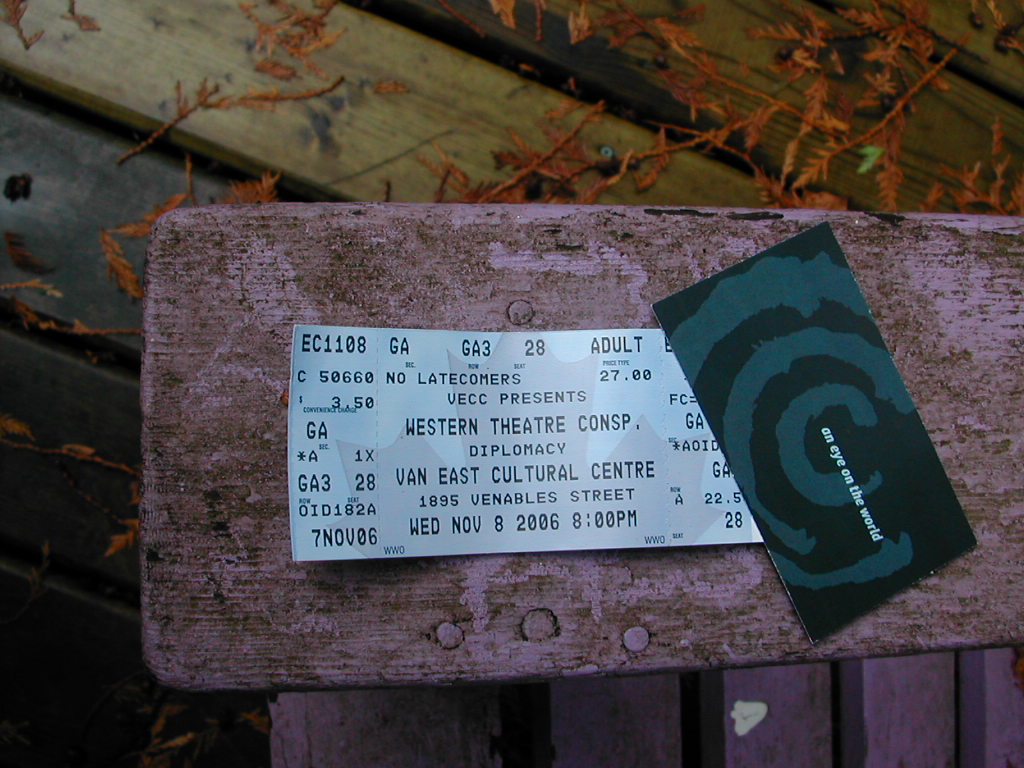
Tonight, I went to a wonderful play at the Vancouver East Cultural Centre. A piece by Tim Carlson, called “Diplomacy”. Set in Ottawa (where else, with a title like
that?), it reveals the disintegration of a man and his beliefs. Roy, the focal character, is a Vietnam draft dodger who came to Canada in the mid-’60s. Over the course of his career, he’s written a book about Lester Pearson, and distinguished himself as a tenured professor who believes in and teaches peace. Set in the present, it raises questions we need to be asking about what we’re doing in Afghanistan – as well as what’s going on in Iraq or Lebanon or pretty well anyplace else in the Middle East.
Central to the story is remembering. Whether that’s remembering another war that was based in lies (are they all?), or remembering the Buddhist monks who immolated themselves (or for that matter, Norman Morrison, a Quaker who did the same thing).
Carlson’s script leads us from one revelation to the next, and never hits us over the head, even though some of his characters do exactly that. I loved the fact that at the end of the show, people were asking each other, “So, was he a terrorist?” Unresolved was the only ending such a play could have had.
And then, during the long ride home, there was the calming voice of Eleanor Wachtel on the radio. She was talking with the just-announced winner of the Giller Prize, Vincent Lam. He spoke a bit about his background (his parents grew up in Saigon, came to Canada separately during the Vietnam War). He mentioned how as immigrants, his parents had worked at just about every kind of job – short order cook, you know the drill. Only now, how his father is a Canadian diplomat.
A diplomat, a play called “Diplomacy” – sometimes it all just seems to go in such a circle. Remembering the past and, hopefully, learning from it.
The play runs through Remembrance Day, so there's still time to see it. The planet Mercury eclipsed the sun today. Maybe there really is some kind of change on the wind.
Then in my emails I found a message from my friend, Jean. She offered a reminder that today is the 90th anniversary of the Russian Revolution. I found some odd irony in that fact, especially in light of today’s announcement that Donald Rumsfeld, one of the primary architects of the war in Iraq, has resigned. It felt like maybe it would be a day for change.
Later today I wrote my annual birthday letter to Kurt Vonnegut, a tradition I’ve followed for probably close to twenty years. His b’day, if you can believe it, is Remembrance Day, although I think they call it something else in that country where he lives. Still, it is all about remembering – and commemorating the end of a war they once called the War to End All Wars. Right. If only.
Tonight, I went to a wonderful play at the Vancouver East Cultural Centre. A piece by Tim Carlson, called “Diplomacy”. Set in Ottawa (where else, with a title like
that?), it reveals the disintegration of a man and his beliefs. Roy, the focal character, is a Vietnam draft dodger who came to Canada in the mid-’60s. Over the course of his career, he’s written a book about Lester Pearson, and distinguished himself as a tenured professor who believes in and teaches peace. Set in the present, it raises questions we need to be asking about what we’re doing in Afghanistan – as well as what’s going on in Iraq or Lebanon or pretty well anyplace else in the Middle East.Central to the story is remembering. Whether that’s remembering another war that was based in lies (are they all?), or remembering the Buddhist monks who immolated themselves (or for that matter, Norman Morrison, a Quaker who did the same thing).
Carlson’s script leads us from one revelation to the next, and never hits us over the head, even though some of his characters do exactly that. I loved the fact that at the end of the show, people were asking each other, “So, was he a terrorist?” Unresolved was the only ending such a play could have had.
And then, during the long ride home, there was the calming voice of Eleanor Wachtel on the radio. She was talking with the just-announced winner of the Giller Prize, Vincent Lam. He spoke a bit about his background (his parents grew up in Saigon, came to Canada separately during the Vietnam War). He mentioned how as immigrants, his parents had worked at just about every kind of job – short order cook, you know the drill. Only now, how his father is a Canadian diplomat.
A diplomat, a play called “Diplomacy” – sometimes it all just seems to go in such a circle. Remembering the past and, hopefully, learning from it.
The play runs through Remembrance Day, so there's still time to see it. The planet Mercury eclipsed the sun today. Maybe there really is some kind of change on the wind.
Subscribe to:
Posts (Atom)