Showing posts with label poets. Show all posts

Wednesday, January 14, 2026

Remembering Nelson Ball

Today would have (should have) been the day poet and publisher Nelson Ball turned 84. Sadly, he died in 2019. 

On Sunday, I joined with other writers in honouring poets no longer on earth in an event that takes place on a bi-monthly basis, the Dead Poets Reading Series. It was my distinct pleasure to be the one to celebrate Nelson. 

The little pile of books in the photo above were the ones I read from. What a joy to be able to share some of his poems with an audience who seemed eager to listen. 

The one on top, In This Thin Rain (apt for this quietly raining day here in BC) accounts for the happenstance of my meeting him. I wrote a review of it for a now-defunct online magazine and somehow Nelson tracked me down so he could say thank you. Not an experience a reviewer often has!

As I noted in my presentation, Nelson's wife Barbara Caruso was hugely important to him. An abstract artist who adored colour, she clearly influenced a great deal of his writing. The poems he dedicated to her were always filled with visual imagery and a lot of colour. I did my best to read a range of his work, poems that always seemed to be the result of close observation, both visually and sound-based. 

I closed with a poem that seemed appropriate for an ending to such a joyous presentation. Here, in its entirety (from a collection with the hopeful-sounding title, Almost Spring) is a poem called "Infinity" -- a little bit philosophical, I suppose. Somthing to think about...

There is 

no infinity--


only large numbers


growing

larger 


Thursday, March 21, 2024

Poetry, poetry, poetry

Today is World Poetry Day, a time when it seems appropriate to remember Brian Brett, a poet and friend who died earlier this year. 

When I met him, he was 21, and I wasn't much older, so we had a few years to get in each other's hair. 

He spent a third of his life in White Rock, and was a feisty member of the community I've been part of for more than half of my life. If you clicked on the link in the line above this, you might still be blinking from all the flashy lights. Trust me, the place used to be much different--White Rock was quite a sleepy little seaside town where most of us had at least a passing recognition of one another. The sea is still here, though to get near it by car, you need to be prepared to pay hefty parking fees. 

But this isn't about the town (even though Brian served a couple of terms as a City Councillor, a position that was then back known as 'alderman'); it's about poetry and one of the finest writers to ever pass through here. 

The photo above, though it's not easy to see, is one of the touching mementos his family set out at his recent memorial service. It's the chair where he often sat (and nearly always pontificated from), along with a favourite hat and vest, as well as his famous peacock-themed suspenders. 

Without much poking around on YouTube, it's easy enough to find videorecordings of Brett reading his work, but to get you started, here's a link to one of the shorter (and funnier) ones--a good way to celebrate both Brian and World Poetry Day. 


Wednesday, April 20, 2022

Three stars will shine

I'm not pretending to know what happens to a person after they die, but it's hard not to think of the most recent of our losses as writers who deserve to each become a star in the heavens. 

The first of these, Brian Fawcett, died at the end of February. Considered by many as a Toronto writer, it always seemed his heart remained here in BC, specifically in Prince George where he was born and grew up. 

He said his goodbyes on Facebook, commenting in that wry way of his, that he knew the end was coming and that the words he'd posted would be his last on social media. I suppose it would have made him happy to know that he was right. 

Midway through March, it would be Ellen Jaffe who would 'leave this mortal coil.' Our paths first crossed in the early 1990s when we were co-judges for a poetry contest for the League of Canadian Poets. Soon after that, we found ourselves working as co-editors for another project for the League, and it wasn't long after that when we finally met up. Our friendship endured over the years; I ended up writing a blurb for one of her books of poetry. When one or the other of us travelled east or west, we'd invariably find the other and at least have a good long gab. 

She took the time to phone me ten days before she died. She wanted me to hear it from her that she was going into hospice. I knew she'd been doing cancer treatments for months and months, and that it had been a recent decision to stop taking them, as they were no longer offering effective treatment. So although I was sad, it wasn't a big surprise when only ten days later, she was gone. Her son was kind enough to phone me when her time came. 

But then yesterday, yet another death, and this one came with the blunt force of shock. I knew Steven some, and had once interviewed him for a literary magazine. But I knew him best by way of his writing. He was prolific, as the pile of books on his website will attest, and many of them earned him awards.

Because this is National Poetry Month, last week at our local Open Mic, participants all had to read a poem. It didn't have to be a poem they had written, they just had to give credit to whoever had done so. I read a poem, but not one of my own. Without knowing he was ill, I read a poem by Steven. It's piece that was included in the book of his that I'd read most recently, the one in the photo above, Reaching Mithymna. Oddly, it's the only poem included in the book, which is actually a memoir of his experience in 2015 when he was a volunteer in a refugee camp. If you scroll to the bottom of this obituary on CBC, you'll find the poem I read, "Christmas Work Detail, Samos." I'd chosen to read it because it seemed like the strongest poem I knew to deal with the daily crises facing refugees, so many of whom keep streaming out of Ukraine. It's a poem that's bound to stay with you, just as my memories of these three wonderful writers are bound to stay with me.  


Friday, February 26, 2021

And the beat goes on...

Earlier this week, news came that Lawrence Ferlinghetti, whose name has long been associated with the "Beat Movement" had died. Almost 102 years old, he certainly had a good run. 

In addition to being known for his writing, he and a partner started the famous City Lights Bookstore in San Francisco, a shop I can vouch for as being an almost magical place. Apparently, a memorial for him was held in the laneway adjacent to the shop, a short street known as Jack Kerouac Alley. 

Sadly, Ferlinghetti is not the only poet who's died during this long and lonesome winter. 

The wonderful Ontario poet, Michael Dennis left us on the last day of 2020. Poking around on his blog, "Today's Book of Poetry" where he was constantly reviewing books, is sure to lead you to discovering someone new. 

Earlier in the year, Vancouver lost d.n.simmers. If you click on the link for him, you'll see, in amongst photos of him, a shot that was taken at City Lights Bookstore -- the one with the 'Door' sign. 

Lost to us, though at least we have their books. So yes, I suppose the beat does indeed go on. 

Tuesday, March 12, 2019

Disturbing

Events of the past few days make me think of what Obi-Wan Kenobi says when the planet Alderaan is blown up: that there's been "a great disturbance in the force."

That's how it's felt, with altogether too many deaths, both global and personal.

The globe-shaking event has been the deaths of 157 people on the Ethiopian Airlines flight. So many of the victims were involved in humanitarian or environmental causes. Today's newspaper headlined their profiles with the tag, "They wanted to change the world." No wonder the UN called its members to stand and observe a moment of silence. 

Yet there've been even more deaths -- what might have to be called a spate of them. Thursday alone was the day one of our best known poets Patrick Lane died, just days shy of his 80th birthday, a day when his family planned to celebrate.

Sadly, he wasn't even the only one to go that day, not even the only poet. Carl Leggo, a poet and teacher at UBC, a man who inspired many Vancouver writers, succumbed to cancer on the same day.

Perhaps more quietly, at least with less public notice, the son of a longtime friend died that same day -- of the identical cancer as his mother, right down to it appearing in exactly the same spot.

So the weekend was one of sadness and remembering. But this particular rift in the force hadn't yet finished announcing itself.

Yesterday morning, Joe Rosenblatt, yet another of our country's great writers breathed his last. He'd been ailing for a long while, but still, no one was ready for this. His publisher was in the final stages of printing covers so he could bind Joe's new book, Bite Me! The only blessing in Joe's passing is the fact that the first review of the book came out on the weekend, and hearing that a friend had taken the time to read it to him.

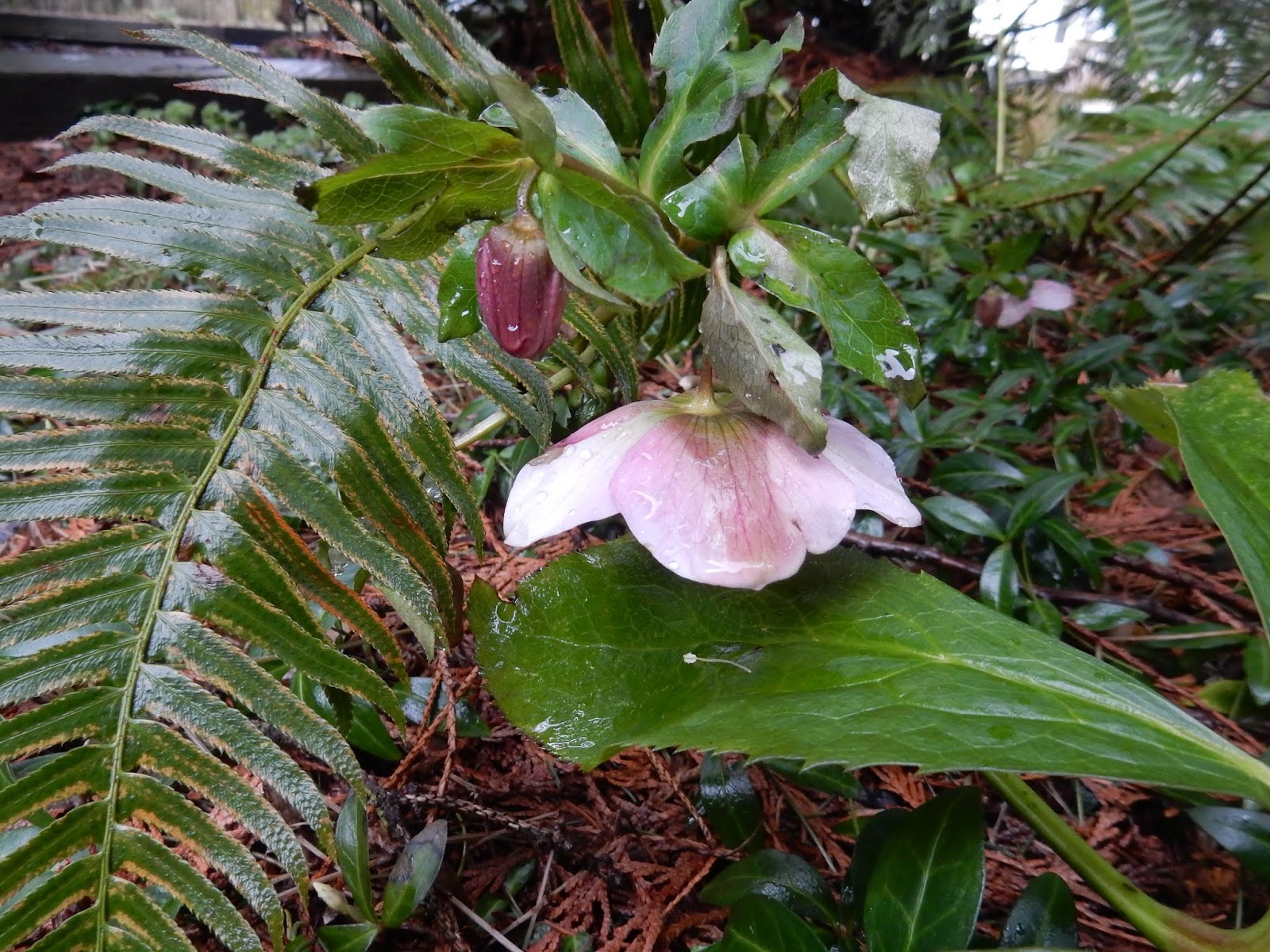
As for the rest of us, certainly, we go on. But not without feeling saddened, diminished. Even the hellebore's blossom, outside this morning, looks as though it too feels the need to grieve.

Monday, January 29, 2018

A wee bit late

I suppose any die-hard traditionalist would find it terrible to be observing Robert Burns' birthday this late in the month. But it turns out this was just the first day we could manage.

Even as we bump along in our non-traditional ways, we try to keeping a few of the 'auld' rituals. One of these is celebrating with a homely version of the Burns Night Supper that isn't exactly what true Scots might be serving.

At least the centrepiece of the meal was the traditional haggis, a food that is apparently illegal in the US.

I admit to cheating, and to buying this haggis from our local butcher shop -- and I even admit to quite liking it, though I probably wouldn't want it all the time.

As for the accompaniments, they weren't exactly what they were supposed to be, but made up from ingredients that were in the fridge, the pantry, or the garden.

The pantry and fridge elements lent themselves to the "MacRoni" and cheese -- made with a nicely respectful Cheddar (aged) at that. And the other side dish wasn't exactly 'neeps and tatties' (turnips and potatoes), but a pretty good facsimile with freshly-dug Jerusalem artichoke, one of the items remaining in the kitchen garden.

Burns Night celebrates the life of a poet, so I probably need to cite a few lines of his that befit the occasion:
Some hae meat and canna eat And some would eat that want it. But we have meat, and we can eat. Sae let the Lord be thankit. 
To that, I can only add an after-dinner Amen.

Tuesday, September 12, 2017

Eyes of heaven

One of my favourite reading series celebrates the work of poets who have died. There's nothing hokey or ghoulish about this -- it's no seancey nonsense -- it's brought together every two months by a group of very-alive writers, and it's called Dead Poets Live.

I always learn about some poet I've never heard of before. This time the poet was a man named Kabir. Unbeknownst to me, he lived in the 15th century and was considered by many to be a saint. Who knew? I have to credit Kate Braid, who told us that she first discovered one of his books in a second-hand bookstore. The selections she read made me want to learn more. And learning more is what often happens at these readings. Alban Goulden presented a selection of work (and much in the way of enlightening comments) on Paul Valéry. Goulden even included some of his own translations, explaining his dissatisfaction at some he encountered.

Even though these first two presentations were engaging, the second half really kicked into high gear, as these were works by three poets nearly all of us in the audience had known -- three poets who each died too soon.

Weldon Hunter presented works by Nanaimo poet Peter Culley, whose death took all of us by surprise when we were at the Cascadia Poetry Festival in 2015. Hunter read from each book in Culley's Hammertown trilogy and told a few wonderfully personal stories about his friend, Culley.

Barbara Nickel was exactly the right person to present the work of her friend Elise Partridge. Well-loved by so many in Vancouver's writing community, like Culley, Partridge died in 2015 when she too was only 57. She wrote brave poems that cut close to the bone, with lines like these from a poem called "Ways of Going" that was dedicated to her partner, Steve:
Sad rower pushed from shore, / I'll disappear like circles summoned /by an oar's dip. 
However I burn through to the next atmosphere, / let your dear face be the last thing I see.

Closing the event was Wayde Compton, reading from work by another beloved Vancouver poet, social activist and essayist, Jamie Reid. I can hardly remember giving or attending a reading where I wouldn't see Jamie, often leaning against a wall at the back of the room. No matter the occasion, it was never 'about him'. But then, that's just the kind of guy he was.

As for the crazy photo accompanying this post, it was after the reading, and I was still feeling kind of spiritualized, I guess, by the emotions that were so evident in the room, downstairs in the Vancouver Public Library. Looking up, all those skylights in the building looked to me like eyes -- and whether they were eyes looking up, or ones looking down, I couldn't be sure. But I felt like, if there is such a place as heaven, there it was, in plain view, nearer than ever.

Thursday, June 12, 2014

O.P.P. notes

If you’ve ever lived in Ontario, you’re probably thinking this post is about the Ontario Provincial Police. But no, the O.P.P. in question here is ‘Other People’s Poetry’.

On Monday, I hosted an event that featured the work of the five poets who wrote the books in the photo above. Those titles were the finalists for this year’s Dorothy Livesay Award, the poetry component of our province’s BC Book Prizes. You can read more about them here (scroll down past fiction and non-fiction to the Livesay finalists). But they’re not the primary focus of today’s rather long post.

Not long ago, Cristy Watson, a writer friend in my community, invited me to participate in something called a Blog-Hop. That idea came from writer and blogger, Kristin Butcher. To see Cristy’s blog (worth looking at, whether you write poetry or fiction), click here. And while you’re clicking, check out Kristin’s too, as she’s the brains behind this whole Blog-Hop dance. 

The Blog-Hop process requires me to answer four questions, which I’ve done, below. But more importantly, the Blog-Hop gives me the opportunity to point you in the direction of three other blogs, each of them by other poets – in other words, they’re places where you’ll find out more about ‘other people’s poetry’ (O.P.P.)

Since I’d prefer to deal with introductions first, may I please tell you about Linda Crosfield. She describes herself modestly, mentioning several journals where her poems have appeared: The Minnesota Review, Labor, and The Antigonish Review. She adds that one of her poems became a miniature accordion book by UpDown Press, and that she produced a chapbook for George Bowering through her imprint, NIB Publishing. She acknowledges a few places where she’s read, including in 2013 at Nelson(BC)’s Elephant Mountain Literary Festival, but fails to mention that she was nearly the hit of the weekend at the recent CascadiaPoetry Festival in Seattle with her hilariously true poem, ‘Nobody Smokes Anymore’. She blogs at purplemountainpoems.blogspot.ca in Ootischenia, BC.

Another poet you'll want to meet is Mary Ann Moore. She's based in Nanaimo, BC. Her book of poetry, Fishing for Mermaids, was published by Leaf Press in April 2014. But she does a lot more than write poems. Mary Ann offers a mentoring program called Writing Home: A Whole Life Practice and a weekly women's writing circle as well as monthly poetry circles called Poetry as a Doorway In . . . and a Welcome Home. She writes a blog at www.apoetsnanaimo.ca and also writes books. It wasn't long ago that she and I shared a page in The Vancouver Sun, with comments each of us were making on new BC books.

The third poet (with blog) I'm introducing is Janet Vickers. A few years ago, she and her husband packed up house and moved to the lovely (though somewhat tricky-to-reach) Gabriola Island. She is a member of Poetry Gabriola and helps organize readings on the island, including one I participated in during National Poetry Month (April). Her first trade book, Impermanence, was published by Ekstasis Editions in 2012. She has long been active in the peace movement and has also been dedicated to other social justice causes. Janet is the publisher of Lipstick Press, which she claims is in the process of re-inventing itself -- very slowly. You can keep track of what those changes might be at the Lipstick Press blog. 

And now, down to my answers to the four questions – the same questions Cristy answered on her blog, and ones you’ll soon see responses to on the blogs of Janet, Mary Ann and Linda.

What am I working on? I’ve mostly been working on everything but writing – a state of being that makes me almost itchy. A week-long trip to Newfoundland saw me involved in networking with friends and colleagues, as the heart of the trip was The Writers Union of Canada’s AGM. (St. John’s – what a place!) I can’t wait to go back. And truthfully, while I was there – in fact, in the midst of the celebratory banquet, no less – came words for a poem about ‘home’. Not finished, still mostly scribbles in a notebook, but then what poem ever is truly finished?

How does my work differ from others of its genre? One of the ways my work differs from others of its genre (and here I’m speaking only of poems) is that I don’t seem to have ever caught on to being able to write to a particular project. The only exception to this would be A: The Amelia Poems, a chapbook published by Lipstick Press (to see more on this press, click on the link for Janet Vickers, above). This ‘poem-here, poem-there’ pattern of mine does not lend itself well towards organizing a manuscript, especially as it seems pretty well all poetry books published in the last decade place their focus on some particular event or at least subject or theme.

Why do I write what I do? I write what I do because those are the words/phrases/lines that I hear in my head. I nearly always start with a scrap of something I’ve ‘heard’ (please don’t call the men in white coats) and then – provided I can later find the physical scrap of paper I’ve likely scribbled it on – I use it as the basis of something longer. The 'heard' line or phrase isn’t always the first line, nor is it the last; often it’s something that turns out to be in the middle. And sometimes, that ‘scrap’ ends up being the title of the poem.


How does my writing process work? Oops. I think I just answered that in the previous response. But then, maybe that just serves to demonstrate that it really is the bit of inspiration that leads me into the actual work of the writing, rewriting and then rewriting some more. Sometimes I think we shouldn’t bother calling ourselves writers, because really, so much of what we do isn’t writing, but re-writing. Maybe I’ll change my business card to Heidi Greco, ReWriter.