Showing posts sorted by relevance for query vonnegut. Sort by date Show all posts

Friday, April 11, 2008

Kurt Vonnegut Interview

It was one year ago, on April 11, 2007, that Kurt Vonnegut died. To commemorate that, here’s an interview with him.
- -
Interviewer: Where you died last April, it’s been a bit complicated figuring out how to arrange this meeting. So really, I have to thank you for helping with the details. For a start, would you please describe where we are?

Kurt Vonnegut: Well, we’re in surprisingly comfortable lawn chairs, relaxing in the well-kept yard of a very solid-looking home. The house has traditional wooden shutters and is surrounded by several grand old trees, under which we are now sitting. If you saw the film, Slaughterhouse Five, you might think this is the same house used on that set. It’s pretty in a way that modern houses no longer are.

Int: Is this where you live?

KV: Mostly. There’s a group of us who stay here off and on, and I’d have to say we get along pretty well. As it turns out, most of the people who live here are members of my karass.

Int: And by that you mean a group that’s something like a family?

KV: That’s one way to explain it, though of course, rarely will someone’s biological family member turn up in their karass. The most surprising person in mine turns out to be Lady Bird Johnson.

Vonnegut disappears with an audible pop. But within seconds, he returns and emits a loud burp.

KV: Pardon me.

Int: I could swear you just disappeared.

KV: I met a few old friends and had lunch.

Int: Lunch? But you couldn’t have been gone for more than a few seconds.

KV: Well, it turns out I wasn’t so wrong when I wrote about time. I said it was there to help humans keep their place in the pages of their lives. That, because it trapped them in the amber of the moment, it provided a way for them to follow along and make better sense of the world.

Int: Hmm. I don’t think I understand.

KV: Think of how your memory works. You can remember all sorts of things – your high school graduation, the first fish you ever caught, what you had for supper last night. In your mind, you don’t have to remember events in the order they happened. You can skip around and remember them any old way. That’s kind of what it’s like here – only all those memories are happening all at once. I can tune into any one of them for a closer look whenever I please.

Again, he vanishes briefly.

Int: Where did you go that time?

KV: Sorry, I didn’t think you’d notice. There’s a particularly sweet fraulein I enjoy visiting. You might call it a barnyard romance – some tasty fooling around when I was a soldier during World War II.

Int: So, does that mean there’s sex there?

KV: Would that surprise you?

Int: Actually, I’m surprised to hear that you eat. I wouldn’t have thought that would be necessary here.

KV: Oh, come on – it wouldn’t be much of a heaven if you couldn’t indulge in a few pleasures. And you’re right, we don’t need to eat, most of us just choose to.

Int: So, what did you have for that lunch with your friends?

KV: I had a wonderful green salad that was filled with luscious surprises – peaches, blueberries and big hunks of abalone.

Int: Abalone? That’s like, so endangered!

KV: That’s only on earth. Like so many of the troubles there, the abalone problem is caused by greed. Here we can have as much of everything as we want. Albert Brooks got it right in that film he made about heaven: you can eat whatever you want here, calories don’t count.

Int: Oh right, Defending Your Life. The one where Meryl Streep digs into that huge plate of pasta! I loved that movie, all that Howard Johnson’s meets Disneyland style.

KV: Um, I hate to remind you, but Albert stole that from me – I had the Howard Johnson franchise delivering last meals to patrons of the Ethical Suicidal Parlor long before he made his movie. Remember?

Int: How could I have forgotten? But speaking of something I forgot, I meant to ask about the time travel thing. What does it feel like when you go to some other place – or should that be time?

KV: Really, it’s both – and it doesn’t feel any different than how this feels right here and now, which is fine, though I do wish you’d get on with the questions.

Int: OK. You admit this house we’re beside looks like something out of the film version of Slaughterhouse Five. So I’m wondering, where’s the antique fire engine?

KV: Ah, even heaven has its petty rules. No fire engines – or cars for that matter. It’s a problem with, as they call them here, infernal combustion engines. The exhaust interferes with the whiteness of the clouds – and some of the more traditional types prefer to live up there (points to the sky), though why, I can’t imagine. It’d get boring, I’m sure – plus there’d be all that white glare. My brother Bernard is one of them who likes it up there, but then, even as a kid he was crazy about clouds. He’s the one who discovered that seeding clouds with silver iodide particles could make them rain. So no, to answer your question, I don’t get to play with fire engines.

Int: Besides that, any regrets?

KV: Not so much regrets as things left undone. I still wish I’d been less of a stinker about allowing a re-release of Between Time and Timbuktu.

Int: What’s that?

KV: It was a great little piece of television drama – don’t sneer, there used to be a lot of great drama on TV – Playhouse 90 is a program they should resurrect. And I think it was ABC that had a terrific series of plays they showed on Thursday nights. Those must’ve run a couple of years at least. Between Time and Timbuktu was based on a lot of my earlier works. There were pieces plucked from Cat’s Cradle and Sirens of Titan and even Happy Birthday, Wanda June. Although I grumbled some at the time, they were strung together into a pretty passable story. There were even some bits from Welcome to the Monkey House, a collection of my early short stories. I have to give the directors credit – they did a damn fine job of a patchwork piece. Casting William Hickey as Stony Stevenson was a step above brilliant. Radio announcers Bob and Ray helped tie the whole thing together. You’d never know it, but a lot of their dialogue was ad-libbed. They were really something!

Int: So, what happened to it?

KV: Who knows? The great beyond of bad moods and unknown bureaucracies and lunatic rules of copyright foreclosures. So it goes.

Int: Ah, one of your most famous lines, “So it goes.” Which brings me to the line most quoted after your passing—

KV: Please don’t use that ridiculous term. It sounds like passing gas and believe me, death is a lot more difficult than farting. It takes work, probably the closest thing to giving birth I ever experienced. God bless you, ladies, especially the mothers of my children and grandchildren.

Int: I’m sorry. Let me start over. After you died – is that better? (Vonnegut closes the famous heavy-lidded eyes and nods) – the quote most often cited was “Everything was beautiful and nothing hurt.” Was that appropriate? Is that what you want to be remembered as saying?

KV: Of course it’s not what I want to be remembered as saying. Most of the people who quote me have never read my books. They saw Slaughterhouse Five on television one night when they couldn’t sleep. And they figure that makes them an expert on me. If they knew my work at all, they’d realize how ironic that epitaph is.

Int: So, would you be happier to be remembered by the quote you once told Rolling Stone Magazine you wanted on your headstone?

KV: I’m sorry, what would that have been?

Int: “The only proof he needed for God was the existence of music.”

KV: Ah, yes. I suppose I would have said something like that to a magazine about the music industry.

Int: So, now that there’s probably a stone with your name on it somewhere, what would you like it to say?

KV: I’d be happy, of course, with the words of Eugene V. Debs. “As long as there is a lower class, I am in it. As long as there is a criminal element, I’m of it. As long as there is a soul in prison, I am not free.” Only those are his words, not mine.

Int: So, as a second choice?

KV: How about, “He tried”.

- -
When the Interviewer thanked the author, she asked whether she’d be able to do more follow-up interviews, perhaps as an annual event. Apparently Mr. Vonnegut replied, “We already are.”

Friday, November 11, 2022

Lest we forget


Remembrance Day. A day for remembering so many important events and people. I love it that even the transit buses bear signs reminding us of the importance of this date. 

The radio has been full of amazing stories of remembering. If you have 15 or so minutes to spare, I'd recommend listening to Matt Galloway's sensitive interview with Candy Greff, this year's Silver Cross Mother who will lay a wreath at the War Memorial in Ottawa. 

One of the people I always remember this day is Kurt Vonnegut. Because today would have been his 100th birthday, it seemed like a good time to interview him again, something he once told me would happen again, so I guess, here we go: 

Interviewer: Well, I suppose the first thing I need to say besides hello again would have to be Happy Birthday. How does it feel to be turning one hundred?

Kurt Vonnegut: What an interesting reminder. Birthdays aren't really of any importance anymore. You must have forgotten how meaningless time is here. Calendars, dates, and whoa -- leap year (what a concept) -- those things are meaningless here. Though thinking of calendars, I recall some lovely scenic images that appeared on those. 

Int: But really, Mr Vonnegut, don't you have any thoughts about having a life that now would have spanned a century?

KV: A century, a minute, a year. It's all the same. When you get here, you'll understand that. As for what it might have been like to turn 100 on earth, I suppose I would have been given a medal or something equally useless to commemorate hanging around that long. And no doubt, the aches and pains I was already learning about would have only been worse. Really, I think I managed to check out at just about the right time. 

Int: Do you ever wish that you could come back?

KV: Not a chance!!

Int: Well, that was a speedy response. Can you comment further?

KV: They've already invited me to go back. There's a whole coterie of folks who think they might do better if they went back. 

Int: Really? Who are some of those we might be looking for again?

KV: You probably won't recognize them, as they won't get the same body, but plenty of folks seem eager enough to go back they'll hang around at the transit stations like puppy dogs hoping for adoption. Some of them whose names you might recognize are Diana Spencer, Adolf Hitler, Jim Morrison -- and oh yes, Marilyn Monroe and John Kennedy. 

Int: That's quite a list. And really, Hitler??

KV: Oh, you don't have to worry. He's been banned from ever going back. He's actually kind of pathetic, as he can't even paint any more, but tries sketching portraits outside whichever station he's decided to haunt. 

Int: And those others you mentioned? 

KV: Well, the Kennedy-Monroe request is especially tricky, as they want to go back so they can be together, but the only way that works is if they go back as twins, and that's not really what they're hoping for. As for Diana, even princesses don't get everything they want, though I thought that was one of the lessons she'd already learned. 

Int: What about you? When are you coming back?

KV: They've invited me -- more than once. But I keep turning them down. I mean really, there's hardly a continent that doesn't have some kind of war going on. Besides, the planet is basically melting. 

Int: Gosh, you're depressing me. Why do you do that?

KV: That's not my intention, dear. I'm only doing what I always did -- trying to make you think. 

Sadly, at that, he disappeared, back into wherever/whatever it is where he now dwells. Maybe next year, 101, we'll see. 

Wednesday, November 11, 2009

Remembering

Just before 11:00 this morning, I turned on the radio to see what sort of acknowledgement of Remembrance Day there might be. As I'd expected, there was a bugler as well as a piper playing the traditional mournful songs, but most striking was listening to the moment of silence. Not the usual 'sound' one expects from the radio.

The photo above shows a replica of World War I's famous Sopwith Camel, a structure that was on display in our local mall as part of Veterans' Week. As you can imagine, it drew quite a lot of attention.

This is also another of the many days when I remember my dad, who piloted a bomber in World War II. Like so many men who fought, he rarely spoke of his experiences in the war.

And there's another person I always remember on this day -- a man who not only spoke about his war experiences but who wrote about them -- Kurt Vonnegut. Ironically, his birthday was November 11th. I couldn't help thinking of Vonnegut earlier this week, when I ran across a YouTube posting of an ice cube being subjected to heat but not melting. It worried me, as it sounded much too much like Vonnegut's Ice-9, the material that debuted in his Cat's Cradle.

Saturday, September 08, 2007

Literacy Day (or is that Listeracy Day?)

It seems appropriate that today, International Literacy Day, the Vancouver Sun’s arts
pages should feature a literature-related installation in the gallery at SFU.
It’s a new piece by Douglas Coupland and presents 50 books that he’s read more than once.

This made me think about some of the books I’ve read multiple times. Top of the list (I’m sure I’ve read it at least 33 1/3 times) would have to be J.D. Salinger’s Catcher in the Rye. The ‘third’ would be for the last time I skimmed it, when it played a role in a Freedom-to-Read event.

I’ve started a list of other books that I’ve read more than three times. These include, in no particular order:

Earth Abides by George R Stewart

all of the Tintin books (Hergé)

David and the Phoenix by Edward Ormondroyd

The Narnia Series (all seven books) by C.S. Lewis

The Bone People by Keri Hulme

Slaughterhouse Five by Kurt Vonnegut

Cat’s Cradle by Kurt Vonnegut

Ecotopia by Ernest Callenbach

Stranger in a Strange Land by Robert Heinlein

Alas, Babylon by Pat Frank

The Hitch Hiker’s Guide to the Galaxy (first book only fits this ‘many times’ category) by Douglas Adams

The Secret Garden by Frances Hodgson Burnett

Island of the Blue Dolphins by Scott O’Dell

The Green Knowe books by Lucy M. Boston

Woman on the Edge of Time by Marge Piercy

Looking through these, it becomes obvious that my taste for repeats finds its focus in fantasy, children’s lit, and science/speculative fiction. In other words (so what else is new?) – I can’t seem to grow up.

Friday, November 11, 2016

Seeking wisdom


Kurt Vonnegut was born on November 11th, 1922.

One of my long-held traditions was to write a letter to him on that day.

He never replied to any of those letters (heck, I don't even know whether any of them reached him), but I kept up the tradition for many years. Much, I suppose, the way I keep this little blog. Sending words out into the universe without knowing whether they might ever connect with anyone.

In light of all that's occurred this week, I'm writing to him again. I just wish that this time, he'd be able to respond, as I'm sure we could use some of his wise advice.

Although, who knows, he might just go along with the down-home homely advice offered in the sign.

And yes, I wrote some of those letters long enough ago that I used a typewriter, thus the likely now-jarring font:

Dear Mr Vonnegut, 

If you were alive, you'd be turning 94. A somewhat creaky age, I suspect. Not an impossible age, but one where I expect that you'd be slowing down. Nonetheless an age when your sense of wisdom would likely be keener than ever. 

Quite a few of us have had our world upended this week. We were expecting one thing to happen, but instead the opposite occurred. 

The reactions I've heard about have included crying (in all its various manifestations, from tears streaming in shocked silence to tears accompanied by sobbing and even shrieking), vomiting, or going to bed and pulling up the covers. 

Apparently so many Americans wanted to know how to emigrate to Canada that our government's immigration website crashed.  

Then yesterday, the president-elect met with the current president of the US, Barack Obama, a fellow I'm sure you've heard about even as far as Tralfamadore or wherever it is that you might now be. 

If the news cameras can be trusted anymore, the new guy came away from that meeting looking a lot like the kid who's been taken to the firehall (I know how you loved firehalls and fire engines) after being caught playing with matches. Sobered right up. Or, to put it in Bondian terms, "shaken, not stirred." *

The only positive spin I can manage on this is that it's just part of the cycle of big change that's been coming for such a long time. Again, I look to thoughts Tralfamadorian as I do my best to come to an acceptance of the reality of now. 

One of your writer-colleagues, Toni Morrison, offered some good advice: "This is precisely the time when artists go to work. There is no time for despair, no place for self-pity, no need for silence, no room for fear. We speak, we write, we do language. This is how civilizations heal."

To that, I imagine you would wholeheartedly agree. After all, doesn't that pretty much sum up how you spent your life here on this little blue planet?

It's Remembrance Day here in Canada, Veterans Day in the US, so I turned on the radio a few minutes ago -- just in time for the moment of silence. Thankfully, that's not a sound one gets very often on the CBC. 

Several speakers then offered remembrance and, as is always the case, in both official languages, French and English. But this year, they added something I didn't remember hearing before, another speaker offered these in a First Nation tongue. Yes. A time for healing. Hallelujah

Which brings to mind one other bit of news. A very cool fellow should have arrived in your zone last night. His name is Leonard. I expect the two of you should find plenty to talk about. 

Best cheers, as always,

hg

* Explanation of this phrase brings to mind another of your works, Cat's Cradle, with its exploration of the properties of ice, a fascination held in what we call 'real life' by your brother, Bernard


Tuesday, June 06, 2017

On achieving equality

There's a chilling line in a Kurt Vonnegut story about a future I don't believe any of us want to see come true. "The year was 2081, and everybody was finally equal."

It's from a story called 'Harrison Bergeron' in Welcome to the Monkey House. While the idea of equality is a noble one, the way it's achieved in Vonnegut's vision is anything but noble. To achieve 'equality' among everyone, anyone with a beautiful face must wear a hideous mask; anyone with above-average intelligence must wear earphones that continuously blast cacophonous sounds to prevent them from thinking clearly. It's a society with a level playing field, but it's one where the bar has been lowered to the bottom rung.

On the weekend, I attended the On Words Conference of The Writers Union of Canada, a group to which I belong. The overriding theme of the weekend was the issue of equity.

Carmen Rodriguez offered a metaphor of explanation, one that made it clearer than any I'd heard before. She told us to picture three people standing behind a fence, outside a soccer match.. One of the persons is quite tall, one is of medium height and one is very short. The tall one can see a bit of the game, the mid-sized one can reach for the occasional glimpse, but the short one is out of luck. In other words, they're not being given equal opportunity to see the game.

Then someone comes over to the fence with three little stools for them to stand on. Now, the tall one has a good view; the medium person gets a better look than before, but the short one still can't see over the fence. Resolution for the problem? For the tall person, the short stool provides a solution, allowing them to see the game. For the middle-sized person, a stool that's a bit bigger will make all the difference. As for the short person, they will need a very tall stool to look over the fence comfortably to participate in watching the game. Equity. Aha! A chance for all to be equal.

At our family supper on Sunday night, I told Carmen's story and reactions around the table were mixed. One son thought each person should get the same advantage -- that they should all get a tall stool right at the start. Even though the tall person didn't need a tall vantage point, this way would be 'fair' to all with no one person needing more 'propping up' than the other. Interesting.

And then came the suggestion to simply take down the fence.

I'm still not sure how best to handle the question: How do we provide equality to everyone? About the best metaphor I can offer for now is the image of the curving fence above. Maybe each of us needs to find our own place along it.

Saturday, July 12, 2008

drupelets galore

I'm pretty sure the first reference I heard to the word drupelet was in some book by Kurt Vonnegut. Maybe Cat's Cradle, with all its Boko-Maru. Wherever, today was a day for gathering many tiny karasses -- drupelets of beings that make up the fruit we know as raspberries.

While we were picking, a clatter of crows kept engaging in a series of family disputes. Doing anything else, their noise might have bothered me. As it was, I just took refuge by reaching further into the shadow of the leaves and finding some the biggest, softest berries -- the ones that roll off into your hand like fuzzy marbles.

A beautiful day well-spent, and one that will taste good all the way to next March.

Wednesday, December 03, 2014

Change for the better


Last week when I was up on Burnaby Mountain, the mud was deep enough to nearly go over the tops of my boots. This week things look much different up there.

Nearly all of the protectors/protesters have gone home. Why? Because Kinder Morgan has left.

Thankfully, they’re not all that’s gone. So are the charges against nearly all of those brave souls who were arrested. It seems that KM didn’t set their boundaries correctly, or had some problems reading their GPS devices, so their injunction was completely compromised. If their engineers can't read a GSP, it doesn't exactly bode well for the thought of their running more pipeline, or boring through the mountain. 

But the difference this week isn't just because hardly any people are left in the camp up there. The weather has also played a huge role in the change.

That ankle-deep mud has now frozen into solid earth and been covered with a thin layer of snow. Even with footprints in the snow, the ground appears to be healing from all that human traffic.

The frozen mud makes me think of Kurt Vonnegut’s brilliant book, Cat’s Cradle, in which an experiment to rid battlefields of mud goes terribly wrong.

It’s the book that's raised my hackles over fears about the kind of grand-scale water-poisoning that might occur if the frackers have it wrong when they say their actions won’t see oil or gas leaking into the water table.

At first glance, water and oil and pipelines may not seem to be related. But, just as all of us are related, so are all of those concerns. 

Wednesday, April 11, 2007

A day for remembrance

I can hardly type. Two more Canadian soldiers have been killed in Afghanistan. My favourite author, the one I sent November 11th birthday letters to every year, Kurt Vonnegut, has died. What more can happen. I don't think I want to know. Besides, isn't that already the proverbial three? Enough for one day.

Thursday, January 12, 2017

"Are they mating yet?"

Some things in life just don't make any sense. Today's stumper for me is the mystery of the mismatched lids-and-containers.

How is it that when they get washed and put on a shelf, top and bottom are intact, but when I go to tidy their chaos, more than half of them are loners?

I haven't heard any arguments coming from their shelf, so I can't blame this disconnect on domestic discord or messy divorces. As for my question at the top of this page, some may recognize it from the film version of Vonnegut's Slaughterhouse-Five. However it is that this disconnect occurs, I'll admit to being puzzled. After all, I don't think anyone's been sneaking into the laundry room and stealing lonesome bits of plastic for the re-use phase of recycling. If they are, I wish they'd take the lids to go with all those missing bottoms.

And while I'm not exactly saying that there's a black hole behind the washer (though who knows, maybe there is), if there is, maybe it's a companion to the one behind the dryer that keeps chomping down those singleton socks.

Thursday, November 30, 2006

Weeding

No, I haven’t been pulling dandelions. There’s way too much snow. All month, I’ve been sorting my office, trying to make it back into a good writing space instead of a storage catch-all. Part of that has meant sorting books and trying to get rid of some.

In cases where I’ve found doubles, this has been easier, though I admit to still having more than one copy of some of my faves. Why is this? Maybe so I can read with both hands, or in case I want to read in tandem with somebody, aloud? Probably all it means it that I'm some kind of survivalist packrat.

I’m anal enough that most of my books are alpha organized. The authors whose books I have the most of are Stephen King and Kurt Vonnegut. Atwood takes up a goodly space too, though her books are distributed over several areas: fiction, poetry, books about books – she even shows up in biography, as I have Rosemary Sullivan’s The Red Shoes. She really is a lot like that story by Mark Jarman, where Atwood is absolutely everywhere.

I’ve discovered that I have more books by people named Moore than with any other surname. There’s Christopher, John, Lisa, Maureen, Michael. Wright takes second place, with L.R. (Bunny), Richard B., Ronald, and Jane Barker.

Do other people have hotspots in their book collections? Inexplicable relationships blooming on the shelf? I love the fact that Eileen Kernaghan is nestled up to Jack Kerouac. She’s always struck me as some kind of secret beatnik.

Stuck beside him as she is, I wonder whether Audrey Thomas would have had terrible arguments with James Thurber. And there’s Grant Buday, leaning up against Jimmy Buffett. What kind of party might it turn into if both of them showed up?

Eden Robinson could come to the party too; she’d be leading Tom Robbins around. Ivan E. Coyote gets to bring Douglas Coupland. Brian Fawcett drives up with Will Ferguson beside him –how would you ever get a word in edgewise? Henry Rollins and Leon Rooke? Who knows, you might want to duck.

Maybe you don’t need to weed or dust to be reminded who’s residing on your shelves. If you spot any interesting combos on yours, let me know.

Tuesday, November 11, 2008

Remembrances

Today is Remembrance Day in Canada. Being out of the country, I find it odd not seeing a red poppy pinned onto everyone's jacket.
Today is also the day Kurt Vonnegut was born. To observe that event, I always used to write him a letter. And no, I never heard back, but that didn't stop me. If I were at home, and had my books at hand, I'd probably do a browse-through some of his books -- a little surrogate 'visit' with him.

Thursday, November 11, 2021

The power of words

The poppy has likely become the most recognizable symbol of Remembrance Day. And it's all because of a poem written by John McCrae, one so many of us can recite (at least partially) by heart, "In Flanders Fields". 

We don't always realize the power of our words, and I'm sure McCrae had no idea that I (and a lot of other people) would be wearing a red poppy on my lapel all these years after World War I, over a century on. 

McCrae is certainly not the only poet who's written about what was called the Great War. The most famous of these is probably Wilfred Owen, though there are others, including a woman, Vera Brittain, whose poetic contribution was a volume called Verses of V.A.D. She was better known for her prose writings, one of which, Testament of Youth, sounds as though it will be coming out as a film. 

Many others have written novels set during World War I. Two that come to mind are June Hutton's Underground, another is Deafening by Frances Itani. 

But Remembrance Day isn't only about remembering the First World War. It's a day for being grateful for all of those before us who fought for a way of life we too often take for granted. 

And one special remembrance I always keep on this day is the fact that it's the birthdate of Kurt Vonnegut, a writer who certainly solidified his reputation as being anti-war with his memoir-based novel, Slaughterhouse Five


Monday, December 30, 2013

Books: the year's best titles

I'm not kidding when I say the best titles, as that's exactly what I'm talking about. A few of these are books I've read, but truthfully, one of them is a book I've never even held in my hand (or, for those who prefer the world of e-life, downloaded).

I would have loved to include Words the Dog Knows, only it was published way back in 2008, so I can't really count it, even though I only got around to reading it this year. It's a fabulous title and a pretty darn good book inside as well.

I think a lot of authors were inspired to better titles after Mark Haddon's The Curious Incident of the Dog in the Night-Time came along (an excellent read, by the way, worth digging for).

Still, contenders for this year's Best Title include:

The Oil Man and the Sea -- not only for its delightful punniness, but for its timeliness and courage, speaking out about the precarious times we are experiencing in BC and exactly how much is at stake.

We Are Born with the Songs Inside Us -- it's hard to beat the sheer beauty of these words in combination. Besides, this book holds some good news for a change, as it's Katherine Gordon's gathering of hopeful words for the future of First Nations Peoples in our country.

Another book with a beautiful title and wonderful insides is Stephen Reid's A Crowbar in the Buddhist Garden. A collection of Reid's writings from prison, it's a book you won't soon forget.

One that I still hope to get to is Milk Spills and One-Log Loads (and we think traffic is hazardous today), written by a fellow who began his career as a truck driver when he turned sixty. This guy's life sounds like one that won't be repeated unless something puts us back into horse-and-buggy mode.

And my list wouldn't be anywhere near complete without the inclusion of Douglas Coupland's latest, a title distinguished by its use of punctuation. Worst. Person. Ever. Despite the fact that not everybody likes this book, Coupland continues to hold appeal for me. Sometimes, with his irreverence and steady pointing out of the world's ridiculous ills, I think he's become my Kurt Vonnegut surrogate. The book was one of my Christmas presents, and I've purposely made it last to today, which happens to be the author's birthday, and he's turning the magic number, 42. (Er, no, bad arithmetic. Make that 52.)

Read any good titles -- or, for that matter, books -- lately?

Wednesday, November 08, 2006

Elliptical circuits

Among the more interesting items in this morning's paper was the announcement of the 'transit of Mercury'. From what I understand, this is essentially an eclipse. From what I know of astrology, a transit of Mercury suggests change.

Then in my emails I found a message from my friend, Jean. She offered a reminder that today is the 90th anniversary of the Russian Revolution. I found some odd irony in that fact, especially in light of today’s announcement that Donald Rumsfeld, one of the primary architects of the war in Iraq, has resigned. It felt like maybe it would be a day for change.

Later today I wrote my annual birthday letter to Kurt Vonnegut, a tradition I’ve followed for probably close to twenty years. His b’day, if you can believe it, is Remembrance Day, although I think they call it something else in that country where he lives. Still, it is all about remembering – and commemorating the end of a war they once called the War to End All Wars. Right. If only.

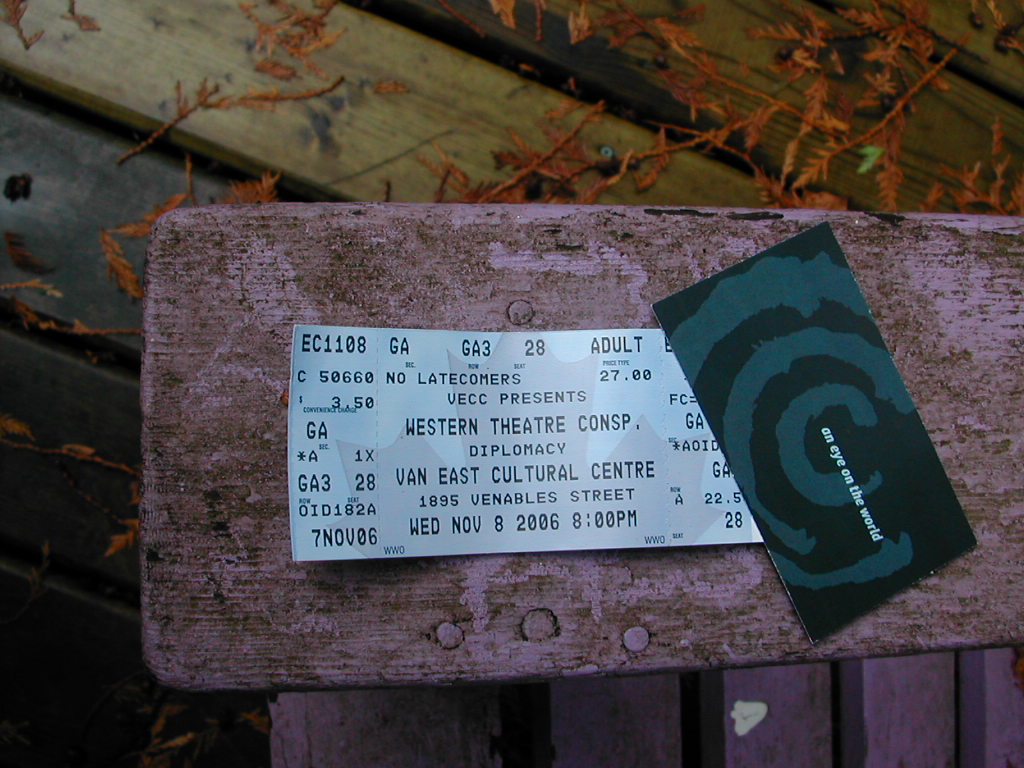
Tonight, I went to a wonderful play at the Vancouver East Cultural Centre. A piece by Tim Carlson, called “Diplomacy”. Set in Ottawa (where else, with a title like that?), it reveals the disintegration of a man and his beliefs. Roy, the focal character, is a Vietnam draft dodger who came to Canada in the mid-’60s. Over the course of his career, he’s written a book about Lester Pearson, and distinguished himself as a tenured professor who believes in and teaches peace. Set in the present, it raises questions we need to be asking about what we’re doing in Afghanistan – as well as what’s going on in Iraq or Lebanon or pretty well anyplace else in the Middle East.

Central to the story is remembering. Whether that’s remembering another war that was based in lies (are they all?), or remembering the Buddhist monks who immolated themselves (or for that matter, Norman Morrison, a Quaker who did the same thing).

Carlson’s script leads us from one revelation to the next, and never hits us over the head, even though some of his characters do exactly that. I loved the fact that at the end of the show, people were asking each other, “So, was he a terrorist?” Unresolved was the only ending such a play could have had.

And then, during the long ride home, there was the calming voice of Eleanor Wachtel on the radio. She was talking with the just-announced winner of the Giller Prize, Vincent Lam. He spoke a bit about his background (his parents grew up in Saigon, came to Canada separately during the Vietnam War). He mentioned how as immigrants, his parents had worked at just about every kind of job – short order cook, you know the drill. Only now, how his father is a Canadian diplomat.

A diplomat, a play called “Diplomacy” – sometimes it all just seems to go in such a circle. Remembering the past and, hopefully, learning from it.

The play runs through Remembrance Day, so there's still time to see it. The planet Mercury eclipsed the sun today. Maybe there really is some kind of change on the wind.

Monday, March 06, 2006

Celebrating Freedom to Read Week


Last week was Freedom to Read Week.

On Saturday, I was part of a group of readers celebrating this event. Besides making me think about the freedom to read, I couldn't help thinking about the freedom to write. So here I go, writing about our event. By the way, that's Liz Bachinsky and her partner, Blake Smith. The people up at the top are Bob, Kasey, and Janet. There's more about all of them as you scroll down. Go ahead and exercise your freedom to read on!

Our celebration offered snippets from books that had been banned or challenged. It also featured "outrageously priced and outrageously sweet" Danishes. And no, these weren't cartoons. These were the real thing, complete with cherries and blueberries.

Author Marion Quednau, who organized the evening, read from the recently-challenged Three Wishes. Written by the well-respected Canadian author, Deborah Ellis, this book presents remarks from Palestinian and Israeli children. They offer their views on how the ongoing conflict has affected their lives. Yet the York (Ontario) District School Board has decided this book is 'inappropriate' reading.

Quednau also read work by the Hungarian writer, George Faludy. His poem, 'Learn by Heart This Poem of Mine' reminds us how fragile freedom can be.

Hearing the Faludy poem reminded me of the Russian poet, Osip Mandelstam. His wife, Nadezhda, went so far as to memorize his poems, as she feared his work might become 'disappeared.' Imagine, keeping someone's work safe by storing it in your mind.


Poet Liz Bachinsky read a poem by bill bissett. He's the poet who drew the wrath of Les Wedman, then Member of Parliament. Wedman railed against bissett's writing and tried to make a case against the Canada Council. After all, it uses taxpayers' money to support the arts.

Liz later read (along with Kasey Kieler) from Bret Easton Ellis' American Psycho. Kasey also read from William Burroughs' Naked Lunch, as did poet Bob Martens. Janet Vickers, yet another poet, read from D.H. Lawrence's Lady Chatterley's Lover. She also read a poem by Pablo Neruda.

Because I used to work in the Surrey School District, I read from two picture books that were deemed unsuitable by that school board. The two I read from were Asha's Mums and One Dad, Two Dads, Brown Dads, Blue Dads. It probably sounds crazy to think of picture books as any kind of threat, especially as the books seem to do a good job of promoting tolerance of differences -- an attitude that is among the goals of the province's primary curriculum.

But apparently in Surrey, tolerance of differences doesn't always apply, especially if 'different' happens to mean gay. The Board has spent a million dollars trying to keep three little books away from children's eyes.

Other artists whose works were read included J.D. Salinger, Kurt Vonnegut, and Robert Munsch. All of them have had work challenged or banned.

It was more than twenty years ago that George Faludy spent time in British Columbia. During that visit, Alan Twigg of BC Bookworld talked with him. Faludy's closing words are as powerful now as they were then: "Poetry, freedom. It is like air. You know you must have it only when it is taken away from you." You're even free to read the whole interview here.